

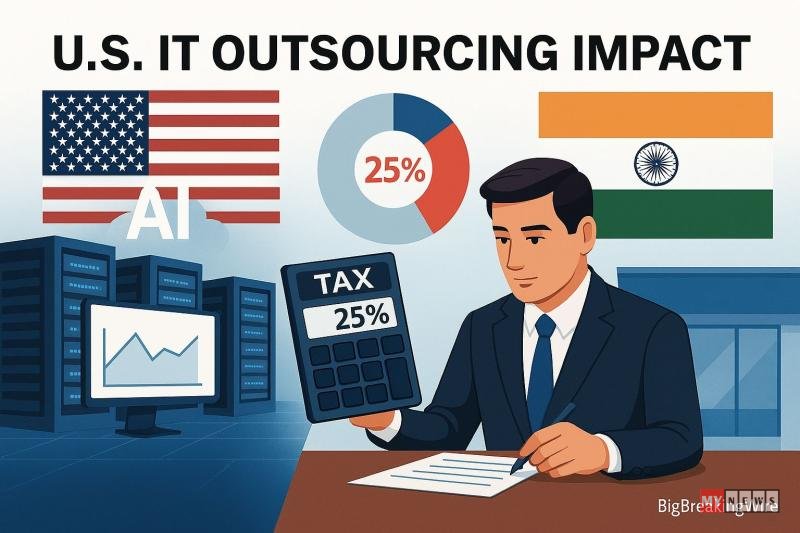
US outsourcing tax bill, introduced in Washington, is raising alarm bells for global IT and service-export sectors. With U.S. lawmakers looking to levy a whopping 25% tax on outsourcing payments, the implications are vast — especially for India, which has long been a global hub for technology services, consulting and back-office support.
US outsourcing tax bill, introduced in Washington, is raising alarm bells for global IT and service-export sectors.
What the US Outsourcing Tax Bill Proposes
The bill, known as the HIRE Act, was drafted by Bernie Moreno (R-Ohio) and aims to impose a 25% tax on any outsourcing payment made by a U.S. company to a foreign firm or individual for services benefiting U.S. consumers. Senator Bernie Moreno+2Reuters+2
Key points include:
-
A 25% tax on outsourcing payments starting after December 31, 2025. The New Indian Express+1
-
U.S. companies cannot deduct these payments as expenses. The Financial Express+1
-
Establishment of a “Domestic Workforce Fund” financed by the tax revenue to support U.S. job-training and apprenticeships. The New Indian Express
Why India and the Global IT Sector Are Most at Risk
India’s technology and business-process outsourcing (BPO) industries rely heavily on U.S. clients. The U.S. is estimated to account for over half of India’s IT service exports. Reuters
Because the US outsourcing tax bill would increase the cost of foreign-based services, several risks emerge:
-
Indian firms may lose cost advantage or be forced to renegotiate contracts.
-
U.S. companies might shift to on-shore or near-shore models.
-
Margins for offshore service providers could compress sharply. mint+1
How the US Outsourcing Tax Bill Fits Into Wider U.S. Policy
President Donald Trump and other U.S. officials have long championed “Hire American” policies, including visa restrictions (H-1B) and tariffs on goods. This outsourcing tax bill signals a new front — targeting services rather than goods. The Times of India+1
What Happens If the Bill Becomes Law
If enacted, the US outsourcing tax bill could lead to:
-
Increased on-shoring of jobs into the U.S.
-
Hybrid models where companies split services between domestic and overseas locations.
-
Contract renegotiations between U.S. firms and Indian service providers.
-
A strategic shift for India’s IT exports, focusing more on higher-value services.
Global & Industry Reactions
Industry analysts warn that even if the bill does not pass in its original form, the uncertainty alone is prompting U.S. clients to delay deals, rethink outsourcing strategies, and assess risk premiums. Moneycontrol+1
What’s Next for the US Outsourcing Tax Bill
The bill still faces political hurdles in Congress: it must pass both the Senate and House and be signed by the President. Meanwhile, companies and Indian service firms are monitoring lobbying efforts and regulatory commentary closely.
📌 Key Takeaways
-
The US outsourcing tax bill seeks to upend the economics of global outsourcing by taxing cross-border service payments at 25%.
-
India’s IT/BPO sectors, heavily reliant on U.S. demand, face significant disruption and strategic recalibration.
-
The bill forms part of a broader protectionist shift in U.S. economic policy — extending beyond goods into services.
-
Regardless of its passage, the regulatory risk is already influencing contract flows, deal timing and global service models.
Conclusion
The proposed HIRE Act represents one of the most aggressive attempts yet to rewire the global outsourcing ecosystem. For India, which has long relied on U.S.-based demand for its IT and BPO industries, the bill poses a structural threat, not just a policy inconvenience.
As Rajan warns, the shift from taxing goods to taxing services could reshape global labor flows, bilateral business ties, and the economics of offshore talent.
With debate intensifying in Washington, Indian industry leaders, outsourcing firms, and policymakers will be watching closely — because the outcome could redefine the future of cross-border digital work.