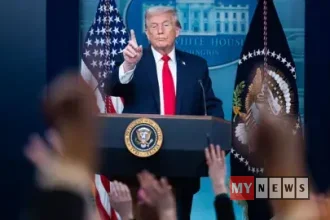

The Supreme Court has struck down some of Donald Trump’s most sweeping global tariffs, upending one of the White House’s top policy priorities and injecting new uncertainty into global trade.
In a 6-3 decision, the justices in America’s highest court said the law Trump used to impose some of his most significant tariffs did not authorise him to do so.
The ruling opens the door to potentially billions of dollars in tariff refunds, delivering a major victory to the small businesses and states that had challenged the measures.
The Trump administration had contended that the duties were justified under a law empowering the president to respond to national emergencies.
But lawyers for the challenging states and private firms said that the law used by the president to impose the levies made no mention of the word “tariffs”.
They argued that Congress did not intend to hand off its power to tax or give the president an “open-ended power to junk” other existing trade deals and tariff rules.
In his opinion, Chief Justice John Roberts sided with that view.
“When Congress has delegated its tariff powers, it has done so in explicit terms and subject to strict limits,” he wrote.
“Had Congress intended to convey the distinct and extraordinary power to impose tariffs, it would have done so expressly, as it consistently has in other tariff statutes.”
The decision applies to tariffs that Trump unveiled last year on goods from nearly every country in the world, in announcements that first targeted Mexico, Canada and China before expanding dramatically on “Liberation Day” in April.
The duties were justified using a 1977 law, the International Emergency Economic Powers Act (IEEPA), which gives the president the power to “regulate” trade in response to an emergency.
Trump said the levies were a response to drug trafficking and trade imbalances. The tariffs would encourage investment and manufacturing in the US, paving the way for economic revival, he said.
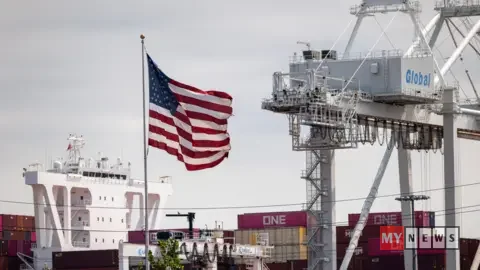
But the measures sparked outcry at home and abroad from firms facing an abrupt rise in taxes on shipments entering the US, and fuelled worries that the levies would lead to higher prices.
The lawsuit had been seen as a major legal test of Trump’s wider push to expand the powers of the White House – and of the willingness of the justices, a majority of whom are conservative, to overturn a policy so central to the administration’s agenda.
The decision to strike down the tariffs was joined by the court’s three liberal justices, as well as two justices nominated by Trump: Amy Coney Barrett and Neil Gorsuch.
Justices Clarence Thomas, Brett Kavanaugh and Samuel Alito opposed the ruling.
Ahead of the decision, the White House had said it would use other tools to impose tariffs, raising uncertainty about the path ahead of trade.
“Things have only gotten more complicated and more messy today,” said Geoffrey Gertz, senior fellow at the Center for a New American Security in Washington, noting that the deal will raise questions about the fate of trade deals many countries struck with the Trump administration to lower tariffs last year.
Businesses across the US cautiously celebrated the decision on Friday, saying they hoped that refunds would come swiftly.
Share markets on Wall Street rose modestly after the announcement, with the S&P 500 up 0.6% in late morning trade in New York.
“This comes as a relief for our employees here in Burlington, Vermont and at our manufacturing facility in Washington State,” said Nik Holm, chief executive of Terry Precision Cycling, one of the small businesses involved in the case.
“Though it will be many months before our supply chain is back up and running as normal, we look forward to the government’s refund of these improperly-collected duties.”
Studies have found that the vast majority of those costs have been shouldered by American companies importing foreign goods and consumers buying them.
In recent weeks, hundreds of firms, including retailer Costco, aluminium giant Alcoa and food importers like tuna fish brand Bumble Bee, have filed lawsuits contesting the tariffs, in a bid to get in position for a refund.
The decision by the majority does not directly mention refunds, likely handing back the question of how that process will work to the Court of International Trade.
In his dissent, Justice Brett Kavanaugh warned the situation would be a “mess”.
Steve Becker, head of the law firm Pillsbury’s international trade practice, said the “best thing” for businesses would be if the government created a procedure that did not require filing a lawsuit.
“I think companies can be fairly confident that they’ll get their money back eventually,” he added. “How long it will take really is up to the government.”
Reporting contributed by Danielle Kaye